Luca Lampariello is an Italian polyglot who speaks 9 languages: Italian, English, French, German, Spanish, Dutch, Swedish, Russian, and Portuguese.
Chinese is his latest language project.
When Luca was barely in his teens (13), he began studying languages on his own. As his experience grew, he came to the conclusion that there is no one best way to learn a foreign language, but there are some universal principles. And handy for us, he believes that the principles should be shared with others desiring to learn a foreign language.
This article will take approximately 19 minutes to read. Don't have the time right now? No worries. You can email the ad-free version of the article to yourself and read it later!
Disclaimer: This article may include links to products or services offered by ExpatDen’s partners, which give us commissions when you click on them. Although this may influence how they appear in the text, we only recommend solutions that we would use in your situation. Read more in our Advertising Disclosure.
Contents
Using these basic principles in his self-study, over the years a simple language learning method evolved.
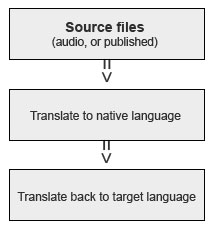
Full circle: Target language (source files) => Native language => Target language
This method enabled him to acquire languages with ease. Ok, it is still a work in progress, but what method isn’t?
To talk with other language learners, Luca joined YouTube. You can find his informative videos on his YouTube channel at poliglotta80.
And YouTube is where I found both Luca and his method.
Luca’s Method
While learning a foreign language is not an easy task, it is not as difficult as it seems.
The idea is this: In order to be able to do something easier than first imagined, one has to be shown how to do that very same thing, only simply. This works for languages too, although it takes more of an effort.
My language learning method
- The timeframe of this method is: Quality, then quantity.
- The method is based upon a strategy of: Often, natural, and sà-nùk.
- The strategy consists of: Listen, read, repeat, translate, and then translate back.
Studying languages with quality and quantity
From the very beginning, put quality time into your studies. The quality aspect makes the difference between an excellent and a mediocre outcome. Put quality into your studies for the first 8 months to 1 year. After that period of time, add an additional ingredient for a solid language acquisition: Quantity.
Quality: What is more powerful than absorbing content? Preparing and training your brain to receive that very same content, that’s what. And if you put the time into absorbing the sounds of your target language, your brain becomes plastic towards that language.
Quantity: Listening and reading become more effective once you’ve built a decent vocabulary. And if you acquire a stable of useful words, you are more likely to understand, enjoy, and learn from books, blogs, articles, and podcasts.
Three basic principles
Often: The first principle is to work on a daily basis. Or, at the very least, 5 days a week. No gigantic amount of work is required either. For the first 3 months, 1 hour a day of study is preferred. Later on you can cut it down to 30 minutes.
Please note that it is more effective to learn a little bit each day, than to cram for 2 long days each week. Trust me. And after a mere 6 months, you will be astounded at your progress.
Natural: The second principle is to learn in a natural way, as natural as possible. The natural way of getting into the fabric of a language doesn’t bother with the heavy tomes of grammar.
It is not that grammar books are not useful. But, given the heaviness of the subject, a strong focus on grammar has a tendency to discourage language learners.
In the first stages of the learning process, it is more fruitful to concentrate on the spoken language by listening to as much dialogue as possible. During this time, write down, in your own words, the bare basics of grammar. No more.
Entertaining: This principle focuses on making your language learning experience entertaining, not stressful.

It is important to inject a bit of entertaining into your lesson plan, so here are a few suggestions:
- Create simple games with the lessons.
- If on a Mac, copy the vocab into aTypeTrainer4Mac.
- Learn a handful of songs each month.
- Laugh at hilarious commercials on YouTube.
- Partner with another language learner.
- Challenge your partner to a language competition.
- At each milestone, treat yourself to something good.
There will be times when you feel frustrated because you can’t recall something you worked on a few days ago. When this happens, allow yourself to relax. Remind yourself that soon enough, those very same worries will seem ridiculously easy.
One other important note: Even if it takes you 8-9 months to finish your chosen beginner course, don’t worry.
The faster one learns a language, the faster one forgets. So don’t learn in haste. Remember that quality is much more efficient than quantity.
Additional Tips
The Internet
Rather than surfing the Internet in search of multiple Thai language courses, concentrate on one set of materials. This is exactly what I do with the Assimil and Teach Yourself series (more about this later).
The Internet is an incredible tool for learning languages, but it also turns a fair number of people into passive learners. What I suggest is to become an active learner by sticking with good material at the exclusion of all others.
And only after you’ve acquired a core of language knowledge, do you head back to the Internet. Because it is at that point that the Internet will become an amazing means to improve your linguistic knowledge.
But until then, please don’t be tempted away by yet another language course. And another. And another.
Pronunciation
A delicate subject to talk about is pronunciation. With some effort, even taking into account linguistic inclinations and ear, I personally believe that most language learners can reach a good pronunciation level.
What I want to point out though, is that it is extremely important to listen to the sounds from the early stages of your learning. And being tonal, this is especially true with the Thai language.
It is not just a matter of listening, but also being able to reproduce the sounds correctly through the proper positioning of your mouth and tongue.
Getting the assistance of a native speaker will accelerate the process of acquiring and reproducing sounds correctly.
Proper pronunciation consists of two main phases
- Pronouncing single words correctly.
- Getting the correct intonation of a whole sentence.
Script, Transliteration, writing vs typing:
I personally use MS Word for my foreign language studies. But, given transliteration and the script, you might very well prefer to handwrite your homework.
The elementary phase
For this phase of the method, I often use the Teach Yourself series. You might be familiar with David Smyth’s Teach Yourself Thai.
It does not matter if you don’t have Teach Yourself Thai. What does matter is choosing a quality course with script and sound.
Note: The bulk of my method concentrates on the dialogues – listening, reading, translating the the language I want to learn into English, translating your English back into targted language– but do not ignore the lesson plan that comes with your language course.
The elementary phase consists of:
- Listen to the audio files.
- Repeat the audio files.
- Read the materials with and without the audio files.
- Translate the language you want to learn dialogue into English.
- Translate your English translation into the language you want to learn (transliteration or script).
When you translate the dialogue (audio, transliteration, or script) into English first, then translate your English version back (transliteration or script), you come full circle.
Note: It is important to translate into English first. I am only emphasising this point because it is often misconstrued by those following my method (and I don’t want you to lose out).
Full circle: Language you want to learn (source files) => English => language you want to learn
The full circle attributes of my method are what makes for a quality outcome.
For this phase, spend an hour a day on your lessons. If studying for a full hour is too much for you, break the hour into 15 or 30 minute sessions.
Two-week schedule
Below is a potential two-week schedule. I use Thai langauge as an example.
Days 1-5: Listen, read, and repeat. Take notes on grammar.
Day 6: Listen, read, and repeat. Translate the first Thai dialogue into English.
To give you an idea on how it will work, Catherine contacted the publishers of Teach Yourself Thai for permission to share the first dialogue.
The sound files for the first dialogue:
The Thai sound files translated into English:
Hello.
What is your name?
My name is Peter.
Peter, you are American?
No.
I am English.
I come from Manchester.
Excuse me.
What is your name?
Day 7: Either give your studies a rest, or review what you have learned.
Days 8-14: Follow the same schedule for Unit 2.
Day 15: Take your English translation, and translate it back to Thai (script or transliteration).
The English translated back to Thai (transliteration):
sà-wàt-dee kâ
kun chêu à-rai ká
chêu bpee-dtêr kráp
kun bpee-dtêr bpen kon à-may-rí-gan châi măi ká
mâi châi kráp
bpen kon ang-grìt kráp
maa jàak man-chét-dtêr
kŏr tôht kráp
kun chêu à-rai kráp
The English translated back to Thai (script):
สวัสดี ค่ะ
คุณ ชื่อ อะไร คะ
ชื่อ ปีเตอร์ ดรับ
คุณ ปีเตอร์ เป็น คน อเมริกัน ใช่ ไหม คะ
ไม่ ใช่ ครับ
เป็น คน อังกฤษ ครับ
มาจาก เเมนเช็สเตอร์
ขอโทษ ครับ
คุณ ชื่อ อะไร ครับ
Tip: When you translate, work line by line. It doesn’t matter if you can’t remember everything, just do your best. Oh, and be sure to check your work for any mistakes.
Complete the rest of the course in this manner: Listen, read, repeat, translate the Thai source files to English, and then translate the English back to Thai.
After 1 month, start talking. Even if you don’t have a native speaker in front of you, imagine that he/she is there. Make an attempt at simple conversations.
Partway through this phase, you will be able to get by in an actual conversation. This is because translating the dialogues back and forth gives your brain the necessary rehearsal time to eventually speak in real time.
After 6 months, everything will be enormously easier.
Second Phase
The second, or intermediate phase, is very similar to the elementary phrase. You will use slightly more complicated texts, which will also need to be translated to English first, and then translated back to the language you want to learn.
I depend on Assimil for this phrase. But to get the most out of it you do need to read French.

The secondary phase lasts 6 months, more or less.
The Advanced Phase
This phrase is centred around talking with locals, watching movies, singing songs, and reading advanced materials. You might have nibbled away at each already (especially movies, songs and conversations) but this phrase concentrates even more so.
- Movies: Watch movies. Take notes.
- Talk: Whenever you can, talk to the locals you meet (in person, or via Skype).
- Sing: Take the time to learn songs.
- Read: Get stuck into books, newspapers, and language sites.
Movies: YouTube and Netflix are a treasure trove for movies.
Talk: You can always join one of the online language learning groups which utilize Skype. As there are too many to list here’.
Awhile back, I was talking with some Americans who asked, “Luca, how can you speak English like that, if you’ve never even been to the US before?”
My answer? For those who praise mp3’s as incredible for learning languages, think further: Skype.
Skype is the real deal. Audio-material – although the old-fashioned tape sound quality was often miserable – has been around for over 40 years. And while Skype has only been around for a short time, it is excellent for learning languages.
Bottom line: Conversations with native speakers are a must.
Songs: Learning to sing in your target language is a part of the entertainment factor we were discussing earlier. Again, YouTube is the place to go (search to find your music style).
Overview of the Method
- The timeframe: Quality, then quantity.
- The strategy: Often, natural, and sà-nùk.
- Strategy breakdown: Listen, read, repeat, translate, translate back.
- Full circle: Thai (source files) => English => Thai
If you use my method, after a year and half (2 years max) you will be very good. And it won’t be a miracle, but a reality.
Anyone, I repeat, anyone, can use my method for self-study and get to an excellent level in a foreign language.
Active Learning vs Passive Learning
I’ve been learning languages by myself since I was 13. As an experienced self-learner, I came to the conclusion that there is no one best method, but there are some universal principles one can stick to and which I think should be shared for the benefit of those who really want to learn foreign languages the proper way.
To start off on the wrong foot can lead to disaster, that is, frustration and giving up the pursuit. It is mandatory to know how to get started. The first phase, which can last 6 months to 1 year (depending on the complexity of the target language and your previous experience) is definitely the most delicate one.
Craving for a quick proficiency is dangerous, because it keeps you from concentrating on your studies. It is like a runner who constantly thinks about still having 15 kilometers to go, instead of staying focused on the track, step by step. Thinking that he’s got such a long distance to cover could get him mentally tired from the very beginning.

I’m sure that many of you eager learners have taken a moment off your language studies and had some “reverie” (fantasized) about yourselves being fluent speakers and communicating flawlessly in the language you are learning. I did that numerous times.
When I was learning German I thought “how incredible would that be to speak it fluently”. That thought made me doubt about my future success and I had doubts often around 6-7 months after starting that language. I was a bit frustrated because I wasn’t fluent yet. How could I be fluent after 6 months? At that time I had no real experience at learning languages, and the worry easily frustrated me. I want to explain to you now why it doesn’t disturb me anymore, even when I’m learning difficult languages such Chinese (as I’m doing now).
I’ve come to the conclusion that if you do a quality work, the results will be terrific in the long run. By “long run” I mean that you have to be positive about the fact that there will come a point where the knowledge that you’ve been accumulating will “explode” (in a good sense), take off. According to some unofficial literature, this threshold is called “epiphany point”. After that point, you find yourself speaking much much better than you had done before. You don’t know why, but you’re happy about it. I’m sure some of you know what I mean. This epiphany point, as I told you, is going to happen at some point of your path, and the more quality you put into building a core in your head, the more brilliant this epiphany point will be.
What is quality work? The quality of your work is absolutely essential to learning a language well. Quality work is steady, efficient and not too heavy, and you impose it on yourself according to your schedule. The aim is that of “building a core” in your head. Knowing how to schedule your work keeps you from being a passive learner. I’ve described some of what I do on YouTube, but I want to share with you the reasons why it is so efficient for me.
During the first year, I focus on listening to that language, but I almost immediately start writing and speaking it. I don’t listen to a huge amount of material. I think it is much more efficient to listen to some material very attentively rather than flooding your brain with hours and hours. I start writing that language after a couple of weeks after the very first start (mostly using Microsoft Word). By retranslating the texts into the target language and then confronting what you’ve done with the texts after a week puts your brain in the position of elaborating phrases directly in that language. It is also a very powerful form of auto-correction and helps you to absorb grammar effortlessly.
Somebody says that grammar is not important and that you can learn a language well without a grammar book. In answer to this: grammar IS important. The whole point is not whether grammar is important or not, but HOW one can absorb it without effort, that is, with a study that doesn’t foresee any heavy and horrible grammar book (which I generally try to avoid as much as I can). So with this simple “retranslating” operation your brain fixes the structures of that language and also provides a script that your brain will use when speaking that language.
I have been wondering for a long time why I see (literally) written subtitles in my head when speaking languages, and I found out that this is due to my way of learning. Having a script in your head links sound to letters and words, and it is of great advantage.

After 3 months, I start elaborating phrases in my head and I start doing the most important thing: I talk, even if I don’t have a native speaker. I imagine having one in front of me and try to think of what to say. Introducing yourself, talking about the weather, family and so on.
There are some “language gurus” who enforce the idea that speaking to yourself is not useful at all, cause nobody is there to correct your pronunciation and your grammar mistakes. I think (but this is just my humble opinion), that this is not sound advice to give. Speaking to yourself might not better your pronunciation, but gets you fluent in a language. A language is also a matter of automatism. If kids don’t speak that language, it is simply because they haven’t developed the physical capacity of doing so. But as soon as they do, you can tell that they literally “crave” words (like when they try to utter the word “mama” after a few months).
As adults, we have the advantage of a fully developed apparatus which we are ready to immediately create new sounds with. My advice is: listen to audio material for a couple of months, start writing and translating texts from your language to the target language, and after another month start having conversations, even to yourself. Of course this has to be a progressive work.
After a year (but it can be much less) you are ready to add quantity to your work. At this point your brain is able to absorb and enjoy a huge amount of input (movies, books and newspapers) much more efficiently and even produce outcome better (both oral and written conversations with native speakers).
If you wonder why people immersed in some language (living in-country) get to speak it fast the answer is extremely simple. It’s because they are FORCED to speak that language on a daily basis. Whereas living in your country makes you lazy because you don’t necessarily need to speak it. If you create your own environment where you are immersed in that target language, even if you still live in your own country, you will learn that language very well anyway.
Which leads to the final point. How to create that environment? I’ve been speaking with some Americans who asked me “Luca, how can you speak English like that if you’ve never been to the US before?” For those who praise the mp3 as an incredible learning resource, think one better: Skype is the real deal. Audio-material (although a tapes’ sound quality was much worse) has been around for over 40 years, but skype has been around for much less. Skype is tailor-made for language learning, and with this wonderful software application you’ll have no more excuses for not getting proficient in languages. A conversation with a native is an invaluable asset.
This article is originally posted by Luca Lampariello